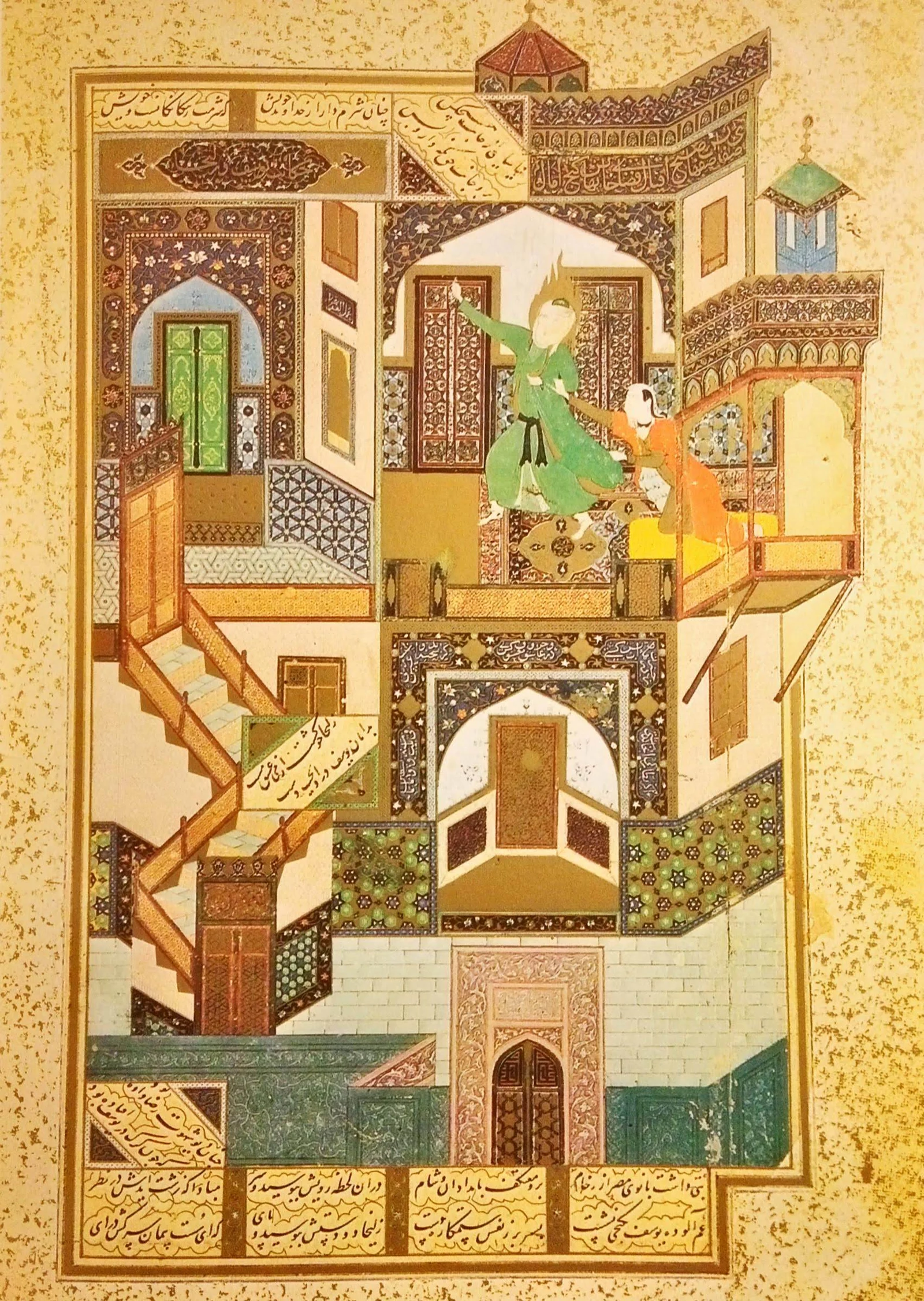
Yusuf and Zulaykha
At a glance
Behzad turns Yusuf’s flight from Zulaykha into a maze of brilliantly patterned rooms and doors on a page of Sa‘di’s Bustan.
Literary narrative
Yusuf and Zulaykha in scripture and Persian literature
Yusuf in Egypt
In the Qur’an, Yusuf is taken to Egypt and grows up in the home of a powerful man. The man’s wife seeks to seduce him and shuts the doors.
Sa‘di’s telling
Sa‘di uses the encounter in the Bustan as a brief moral story. Later Persian treatments also elaborated the setting and the woman, who is known in that tradition as Zulaykha.
Flight and testimony
In the Qur’an, Yusuf flees and his shirt tears from behind. The tear becomes evidence about what happened during the pursuit.
Which moment does the artwork show?
Behzad turns the movement toward doors into the structure of the page. The figures are small, and the architecture carries much of the story.
The story behind the artwork
A story told across texts
The Qur’an tells of Yusuf fleeing the wife of the Egyptian official. Later Persian literature expands the story and names her Zulaykha. The painted architecture draws the pursuit into a complex built setting.
How to follow the page
Stairs, closed doors and rooms face several directions at once. Their sequence makes an itinerary across the page while keeping its decoration directly visible.
A closer look
The two figures come into view after the eye has followed the empty architecture.
An abrupt change in direction connects levels without continuous perspective.
The bright surface makes a barrier visually salient.
The room displays its pattern while taking part in the story’s route.
The text anchors the image as part of a manuscript page.
Sources
Image credit
Folio 52 verso of the illustrated Bustan, Persian Literature 22 at the Egyptian National Library and Archives.
Wikimedia Commons Original file (0.6 MB) Kamāl ud-Dīn BehzādCC BY-SA 4.0Related works
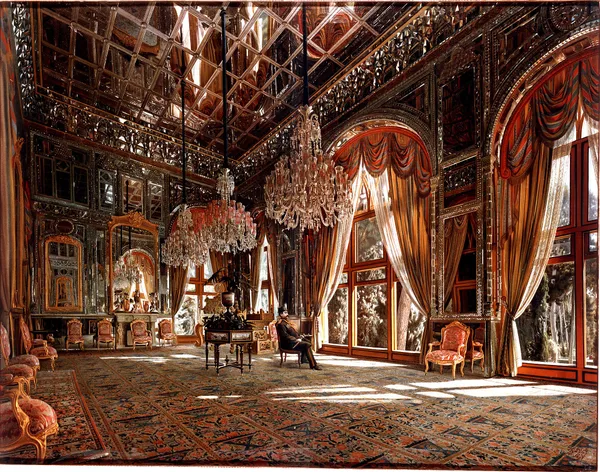
Hall of Mirrors
Mohammad Ghaffari (Kamal-ol-Molk)
Kamal-ol-Molk makes the glittering interior of Golestan Palace the main event, letting the small seated figure of Naser al-Din Shah set its scale.
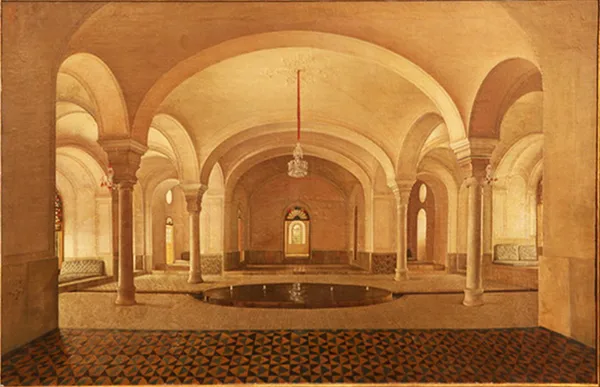
Pool House of Sahebqaraniyeh Palace
Mohammad Ghaffari (Kamal-ol-Molk)
Kamal-ol-Molk paints the pool house at Sahebqaraniyeh Palace with its low basin, repeating columns and hanging lamp aligned along the room’s central axis.
The Evening of Ashura
Mahmoud Farshchian
Mahmoud Farshchian evokes the aftermath of Karbala through the riderless horse Zuljanah and a group mourning around its lowered head.
The Guarantor of the Gazelle II
Mahmoud Farshchian
Farshchian’s second Guarantor of the Gazelle turns a devotional account of Imam Reza and a hunted gazelle into an image of protection and intercession.