The Evening of Ashura
At a glance
Mahmoud Farshchian evokes the aftermath of Karbala through the riderless horse Zuljanah and a group mourning around its lowered head.
Historical account
From the invitations from Kufa to Ashura
A journey toward Iraq
After refusing allegiance to the Umayyad caliph Yazid, Husayn ibn Ali received appeals from Kufa. He travelled in the direction of Iraq with relatives and supporters.
Karbala in 680 CE
Husayn’s party was stopped at Karbala. On the tenth of Muharram, known as Ashura, Husayn and many of his companions and relatives were killed.
Survivors and remembrance
Surviving members of the party included Zaynab bint Ali and Ali ibn Husayn. Karbala became a central event in Shi‘i remembrance, retold in ritual, poetry and visual art.
Which moment does the artwork show?
Farshchian evokes the devotional episode of Zuljanah returning to the tents after the battle. The mourners receive the news through the horse’s empty saddle.
The story behind the artwork
Karbala remembered
On Ashura in 680 CE, Husayn ibn Ali and members of his small party were killed at Karbala. The event became central to Shi‘i commemoration, especially during Muharram.
The riderless return
The horse’s return to the camp is a scene in devotional retellings. Farshchian concentrates on the grief of those around it and lets the lowered head and surrounding curves carry the loss.
A closer look
The markers show where to look in the linked image. Mahmoud Farshchian’s official gallery
The absence of a rider makes the horse the bearer of the news.
Its downward curve meets the sweeping forms of the mourners.
The leaning trees extend the movement of the foreground into the background.
The camp is suggested through a few shapes rather than a complete landscape.
Low, scattered details register the aftermath of a disrupted scene.
Sources
Related works
The Guarantor of the Gazelle II
Mahmoud Farshchian
Farshchian’s second Guarantor of the Gazelle turns a devotional account of Imam Reza and a hunted gazelle into an image of protection and intercession.
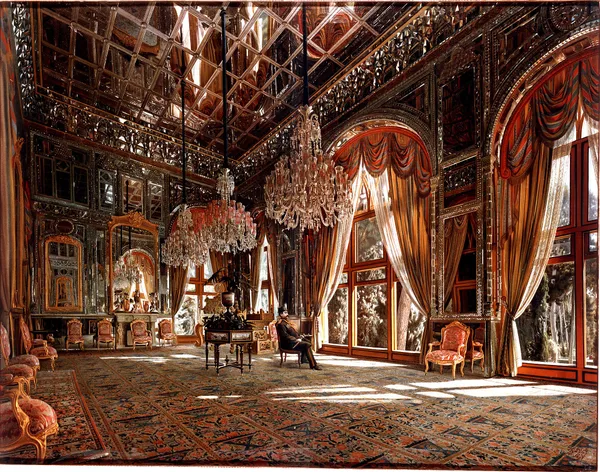
Hall of Mirrors
Mohammad Ghaffari (Kamal-ol-Molk)
Kamal-ol-Molk makes the glittering interior of Golestan Palace the main event, letting the small seated figure of Naser al-Din Shah set its scale.
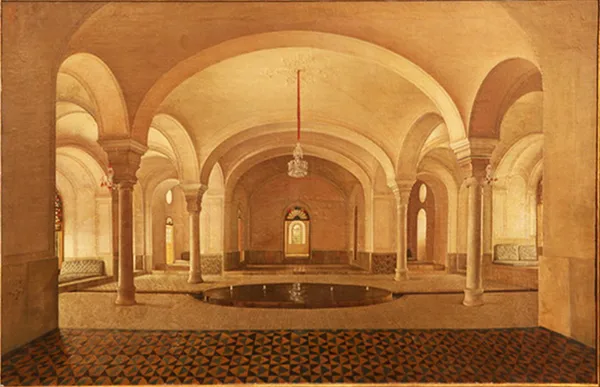
Pool House of Sahebqaraniyeh Palace
Mohammad Ghaffari (Kamal-ol-Molk)
Kamal-ol-Molk paints the pool house at Sahebqaraniyeh Palace with its low basin, repeating columns and hanging lamp aligned along the room’s central axis.
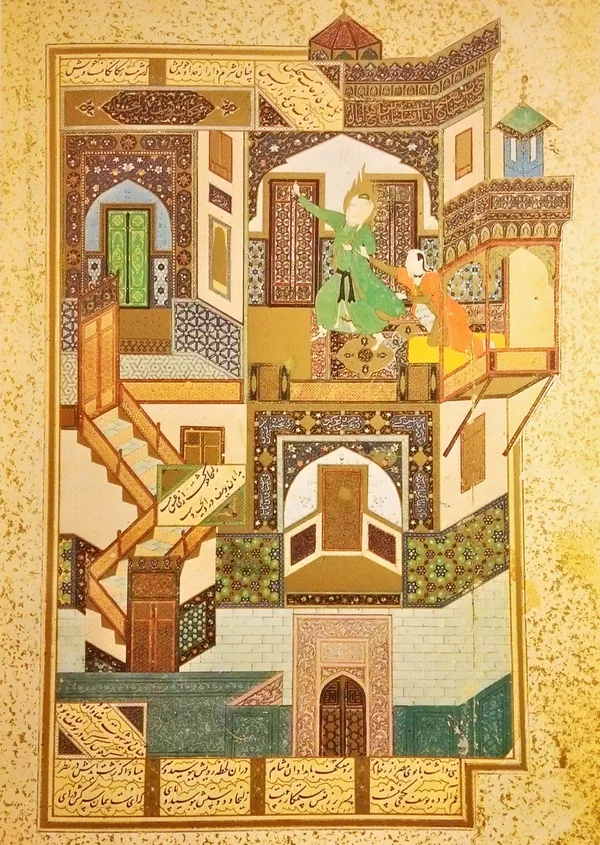
Yusuf and Zulaykha
Kamal al-Din Behzad
Behzad turns Yusuf’s flight from Zulaykha into a maze of brilliantly patterned rooms and doors on a page of Sa‘di’s Bustan.