Primavera
At a glance
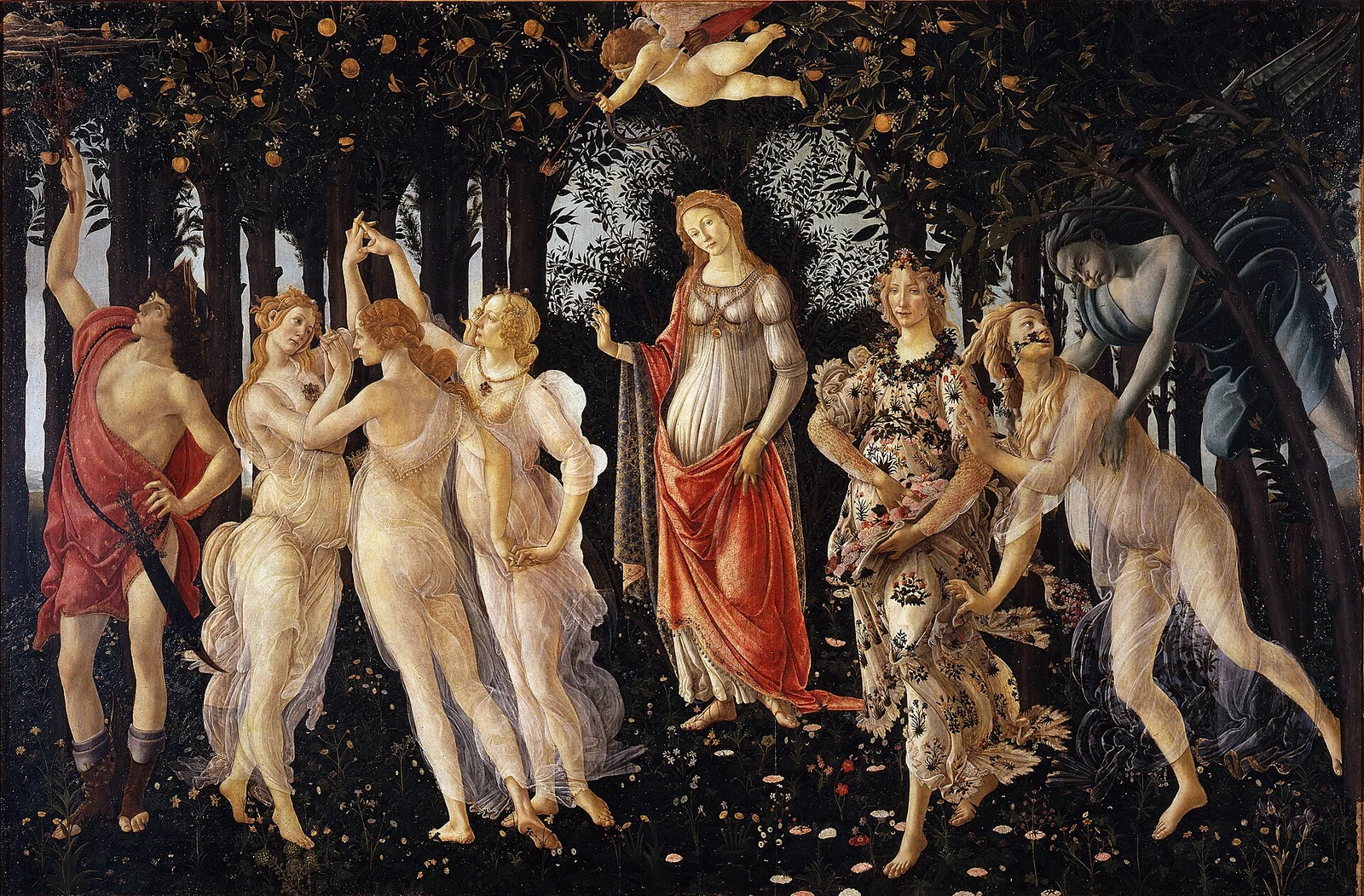
In Botticelli’s Primavera, mythological figures gather in a flowering grove where the movement of spring travels from right to left.
Mythology
Chloris, the west wind and Flora
An encounter in Ovid
In the Fasti, Flora recalls having once been called Chloris. The west wind Zephyrus pursues her in spring.
A transformation told by Flora
The story moves from pursuit to marriage, and Flora receives a garden. She describes her command over flowers and the seasons.
From one figure to the next
The connection between Chloris and Flora offers a way to read the related women at the right of the painting. The rest of the assembly draws on other classical figures and associations.
Which moment does the artwork show?
Botticelli makes successive parts of the story visible together: the pursuit, the first flowers and Flora scattering blossoms.
The story behind the artwork
The garden’s right edge
Zephyrus pursues Chloris, and flowers spill from her mouth. The nearby figure scattering blossoms can be read as Flora, showing the transformation within the space of a few steps.
Venus at the centre
The three Graces dance to the left of Venus beneath a winged Cupid. Farther left, Mercury reaches into the trees. The relationships among these groups have prompted several interpretations.
A closer look
Blossoms trail from Chloris’s mouth and link her to the flower-covered Flora.
Their joined hands make a circular dance amid the dark branches.
His staff reaches toward the canopy, leading the eye toward the upper left.
The small blindfolded figure aims down into the grove.
A dense scattering of plants makes the garden feel both exact and improbable.
Sources
Related works
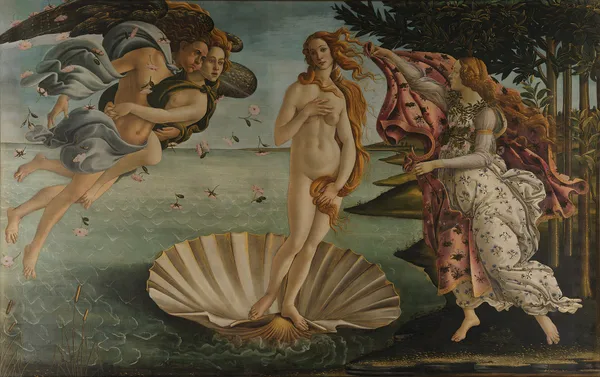
The Birth of Venus
Sandro Botticelli
Botticelli shows Venus arriving at a shore on a shell, swept in by the winds and greeted by a figure holding a flowered cloak.
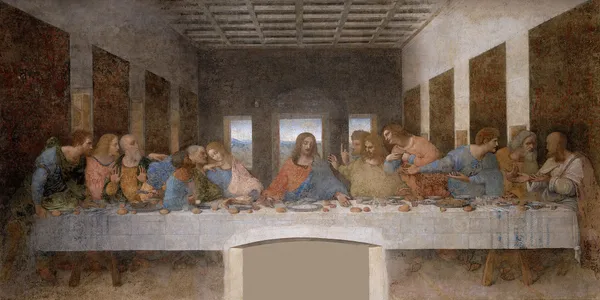
The Last Supper
Leonardo da Vinci
Leonardo places Christ at the centre of a carefully ordered refectory wall while the apostles react to the news that one of them will betray him.
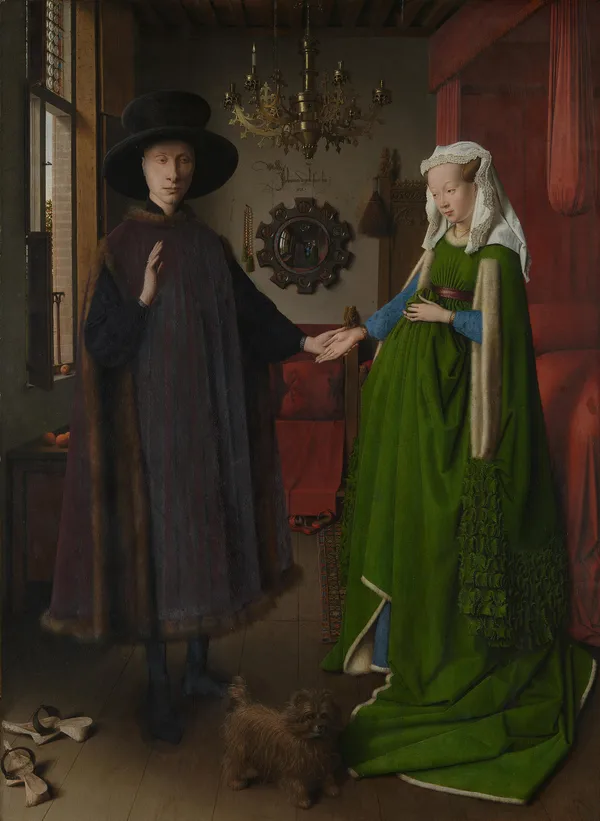
The Arnolfini Portrait
Jan van Eyck
Jan van Eyck’s double portrait stages a meeting in a richly observed room, with a convex mirror that reflects the space behind the viewer.
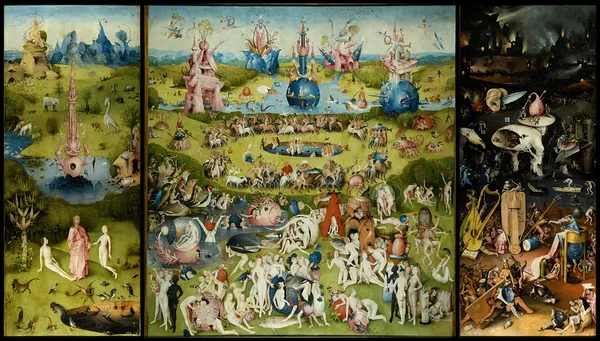
The Garden of Earthly Delights
Hieronymus Bosch
Bosch’s open triptych moves from Eden through a crowded garden of oversized fruit and fantastical bodies to a nightmarish world of punishment.