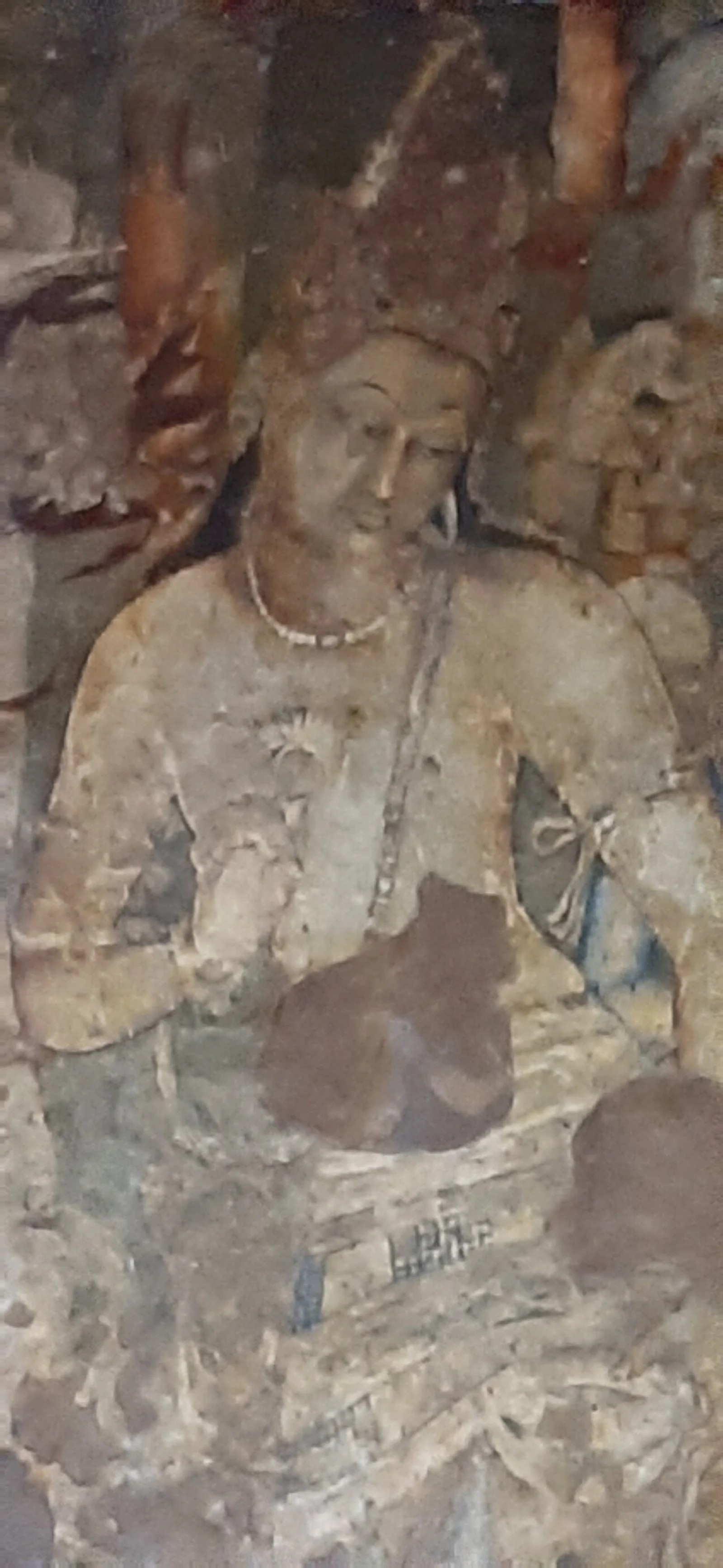
Bodhisattva Padmapani at Ajanta
At a glance
The lotus-bearing bodhisattva in Ajanta’s Cave 1 tilts his head and lowers his eyes, with jewellery and a delicate hand gesture set against the worn wall.
The story behind the artwork
A figure at a threshold
The figure conventionally known as Padmapani belongs to a painted environment around the cave’s shrine. The lotus identifies him with the compassionate bodhisattva Avalokiteshvara.
A surviving painted surface
The lowered eyes and long contour of the shoulder are still legible where other parts have faded. The work is best read in relation to the dim architectural interior and the other figures around the doorway.
A closer look
The slight fall of the lids gives the face a composed, inward attention.
A graceful bend holds the lotus while the jewellery follows a separate curve.
The detailed headdress establishes the figure’s richly adorned appearance.
A long outline connects the head’s inclination with the body.
Losses and irregular paint texture make the condition of the wall visible.
Sources
Image credit
Detail photograph of Cave 1 showing the surviving surface of the Padmapani wall painting.
Wikimedia Commons Original file (1.1 MB) Ranjan Das2CC BY-SA 4.0Related works
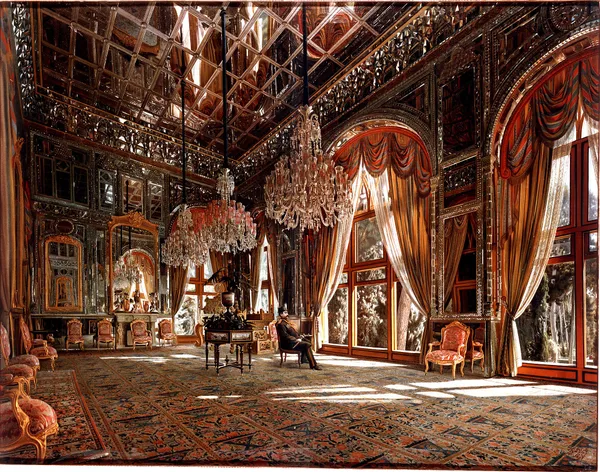
Hall of Mirrors
Mohammad Ghaffari (Kamal-ol-Molk)
Kamal-ol-Molk makes the glittering interior of Golestan Palace the main event, letting the small seated figure of Naser al-Din Shah set its scale.
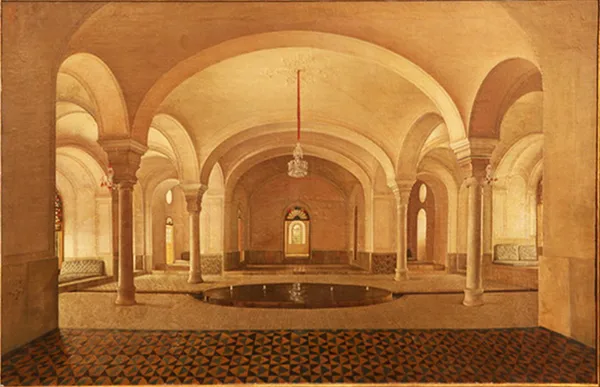
Pool House of Sahebqaraniyeh Palace
Mohammad Ghaffari (Kamal-ol-Molk)
Kamal-ol-Molk paints the pool house at Sahebqaraniyeh Palace with its low basin, repeating columns and hanging lamp aligned along the room’s central axis.
The Evening of Ashura
Mahmoud Farshchian
Mahmoud Farshchian evokes the aftermath of Karbala through the riderless horse Zuljanah and a group mourning around its lowered head.
The Guarantor of the Gazelle II
Mahmoud Farshchian
Farshchian’s second Guarantor of the Gazelle turns a devotional account of Imam Reza and a hunted gazelle into an image of protection and intercession.