
Night Attack on the Sanjō Palace
At a glance
The Sanjō Palace handscroll follows the outbreak of the Heiji Rebellion through a burning palace, airborne rooflines and a rush of competing movement.
Historical account
The night the Heiji Rebellion came to Sanjō Palace
A contest for power
In 1159 political and military factions competed for power at the imperial court. Fujiwara no Nobuyori and Minamoto no Yoshitomo acted while their rival Taira no Kiyomori was away from Kyoto.
Palace under attack
The rebels attacked the Sanjō Palace, which housed the retired emperor Go-Shirakawa. The raid brought fire, fighting and the capture of members of the court into the same episode.
A short advantage
Kiyomori returned and the balance shifted. The rebels were defeated, and the Taira clan gained an increasingly powerful position at court.
Which moment does the artwork show?
The handscroll focuses on the night raid. The eye advances through fires, vehicles and horses in the order the painted scene is unrolled.
The story behind the artwork
Kyoto in 1159
The depicted episode belongs to the struggle for power known as the Heiji Rebellion. The attack on the Sanjō Palace and the seizure of the retired Emperor Go-Shirakawa drew court politics into the streets of Kyoto.
Unrolling a burst of action
The length of the scroll lets viewers meet the violence in stages. Near the palace, overlapping horses, carts and flames make a dense knot before the scene opens out again.
A closer look
Streaks of red and black extend beyond the outline of the building.
Their circular forms punctuate the continuous stream of bodies and horses.
Overlaps show a crowd moving at different speeds.
The sloping architecture drives the eye toward the centre of the encounter.
Text sets the episode in sequence and interrupts the rush of the painted scene.
Sources
Image credit
Full view of the Boston handscroll in the Fenollosa-Weld Collection.
Wikimedia Commons Original file (2.2 MB) Unknown author Unknown authorPublic domainRelated works
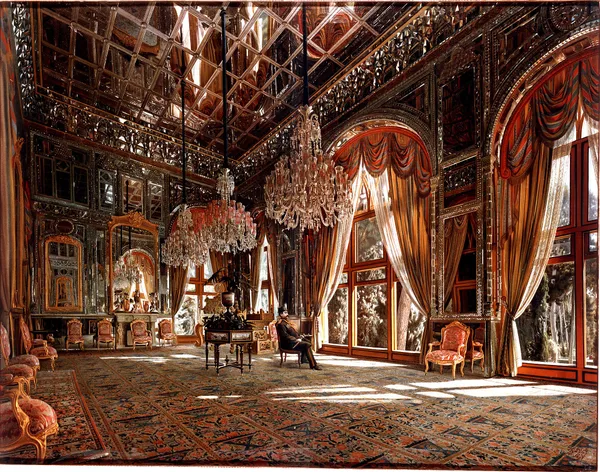
Hall of Mirrors
Mohammad Ghaffari (Kamal-ol-Molk)
Kamal-ol-Molk makes the glittering interior of Golestan Palace the main event, letting the small seated figure of Naser al-Din Shah set its scale.
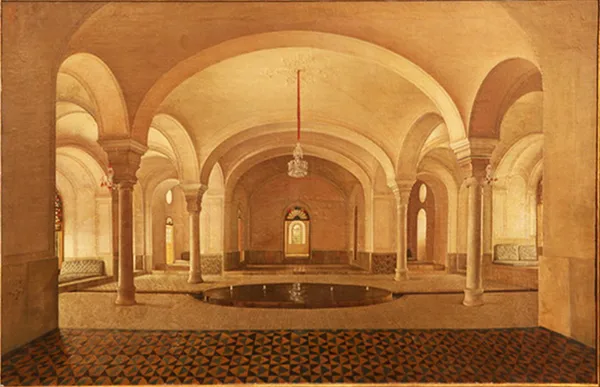
Pool House of Sahebqaraniyeh Palace
Mohammad Ghaffari (Kamal-ol-Molk)
Kamal-ol-Molk paints the pool house at Sahebqaraniyeh Palace with its low basin, repeating columns and hanging lamp aligned along the room’s central axis.
The Evening of Ashura
Mahmoud Farshchian
Mahmoud Farshchian evokes the aftermath of Karbala through the riderless horse Zuljanah and a group mourning around its lowered head.
The Guarantor of the Gazelle II
Mahmoud Farshchian
Farshchian’s second Guarantor of the Gazelle turns a devotional account of Imam Reza and a hunted gazelle into an image of protection and intercession.